Companion Animal Health Fund

-
CAHF Research Grants: 2015-16
This year, the WCVM Companion Animal Health Fund provided financial support for eight pet health research projects at the regional veterinary college. Read the following research summaries for more details about each study. Could a method used to treat liver disease in humans be applied to cats? Drs. Ahmad Al-Dissi and Jolanda Verhoef, WCVM Inflammatory liver disease is the second …
November 19th, 2015 Full story »

-
How Joey got his bounce back
Linda Jensen knew it was bad news when her veterinarian called her on a Sunday night. Dr. Bernard Chapuis, a practitioner in Jensen’s home town of Prince Albert, Sask., had recently removed a lump behind the left front leg of Jensen’s Airedale terrier Joey. “The pathologist at the university [Western College of Veterinary Medicine] had sent back the results and …
January 10th, 2015 Full story »

-
Pigmentary uveitis remains a mystery
My eyes burn and it feels like I haven’t blinked for days. I’ve been sitting for hours, sifting through case files in the records office of the Western College of Veterinary Medicine’s (WCVM) Veterinary Medical Centre. I let out a sigh that erupts a plume of dust: I’ve hardly even made a dent in the mountain of paper before me. …
September 30th, 2014 Full story »

-
Pets bond Gibbs’ work and life
Dr. Brian Gibbs’ decision to become a veterinarian was greatly influenced by one person: his grandmother. “She was probably the last person in Saskatoon to raise chickens and sell eggs,” says Gibbs. “And when I was a kid, I used to catch the city bus over to her place on Friday nights and spend the weekend helping her. I’d look …
August 18th, 2014 Full story »

-
CAHF Research Grants: 2014-15
Metformin: a new potential cancer drug for dogs? Drs. M. Casey Gaunt, Charlotte Johnson, Valerie MacDonald Dickinson and Trisha Dowling, WCVM; and Ryan Dickinson, Prairie Diagnostic Services Metformin is a drug that has been used to manage type-2 diabetes mellitus in humans. Recent studies have shown that the drug may also have the ability to decrease the incidence of — …
August 03rd, 2014 Full story »

-
CAHF and EHRF support local research
Two research funds at the Western College of Veterinary Medicine (WCVM) have awarded over $146,000 to University of Saskatchewan researchers who are investigating critical health issues in horses and pets. The Companion Animal Health Fund (CAHF), which supports pet health research, granted nearly $76,800 to six research teams that include 22 researchers. The Equine Health Research Fund (EHRF) awarded nearly $69,700 toward 19 scientists …
July 11th, 2014 Full story »

-
Ticks 101
April showers bring May flowers … and ticks? That’s right. The increased humidity and warm weather of spring and summer provide ideal conditions for these parasites to thrive, and your pet is the perfect host. “Tall grass and bush are places where ticks like to hang out, so if your dog visits this type of environment, they can pick up …
July 08th, 2014 Full story »
-
Study tests faster cure for UTIs in dogs
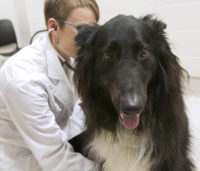
Anyone who has taken antibiotics knows that the longer the treatment time, the more likely a dose is missed. And as the symptoms disappear, so does the motivation to finish the entire vial of pills. Owners face the same challenges when treating their pets with antibiotics. While the typical antibiotic treatment time for women with urinary tract infections (UTIs) usually …
January 06th, 2014 Full story »

-
Put the CAHF on your gift list!
With Christmas just a few days away, the Companion Animal Health Fund (CAHF) can help you track down some final presents for those pet lovers, groomers, pet sitters and veterinarians on your gift list. A gift to the CAHF means a great deal to companion animals as well as to students, faculty and staff at the Western College of Veterinary …
December 16th, 2013 Full story »

-
The twists and turns of research
It’s common knowledge that no matter how well you prepare, research experiments never go perfectly according to plan. I think back to this idea as I watch a team of veterinary specialists try, for the fourth time, to unsuccessfully place a catheter into the spleen of an anesthetized dog. “It [can be] a little bit frustrating sometimes just because it’s …
November 07th, 2013 Full story »