University of Saskatchewan

-
Vets for Pets good medicine for everyone
The man standing in front of Dr. Jane Vermeulen was well groomed, neatly dressed and articulate. When he asked her for a specific flea treatment for his two cats, she assumed he was a staff member from Our Place — an inner-city transition shelter in Victoria, B.C. Our Place is also home base for “Vets for Pets,” a free veterinary clinic …
May 04th, 2015 Full story »
-
Linear accelerator condenses therapy
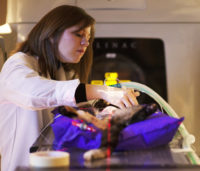
Radiation therapy used to mean that a pet diagnosed with cancer had to undergo 15 to 20 radiation treatments over several weeks at the Western College of Veterinary Medicine’s (WCVM) radiation oncology service. Things changed in February 2014. That’s when the WCVM’s Veterinary Medical Centre became one of only four Canadian locations to offer advanced radiation therapy techniques using a …
February 22nd, 2015 Full story »
-
Digital storytelling nurtures knowledge
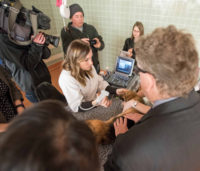
What’s one thing that makes four videos about managing dog populations in the Battle River Treaty 6 area distinct? The fact that they actually exist, says Christina McKenzie, a co-creator of the videos and a second-year student at the Western College of Veterinary Medicine (WCVM). Before she began working on the video project, McKenzie’s research turned up very little information …
February 04th, 2015 Full story »
-
CFI invests in pet health project
Two researchers at the Western College of Veterinary Medicine (WCVM) are among a group of University of Saskatchewan scientists who received funding from the Canada Foundation for Innovation (CFI). U of S researchers will share a total of $844,000 from the CFI for wide-ranging research. The four U of S projects were announced January 20 on the U of S campus by Ed Holder, …
January 27th, 2015 Full story »

-
Pets get physical
In the basement of the Small Animal Clinic in the Western College of Veterinary Medicine (WCVM), Dr. Romany Pinto is working with Kaibo, a brown toy poodle with hip and knee problems. Pinto and her assistant repeatedly move Kaibo—who visits the WCVM Veterinary Medical Centre rehabilitation clinic twice a week—through the motion of sitting and lying down on a foam …
January 27th, 2015 Full story »

-
How Joey got his bounce back
Linda Jensen knew it was bad news when her veterinarian called her on a Sunday night. Dr. Bernard Chapuis, a practitioner in Jensen’s home town of Prince Albert, Sask., had recently removed a lump behind the left front leg of Jensen’s Airedale terrier Joey. “The pathologist at the university [Western College of Veterinary Medicine] had sent back the results and …
January 10th, 2015 Full story »

-
Focus on quality care, balance breeds success
Since I was eight years old, surrounded by barn cats, being a vet was all I wanted to be.” Making the 2014 W100 ranking of Canada’s Top Female Entrepreneurs—a list put together by the editors of PROFIT and Chatelaine magazines— illustrates that Dr. Wendy McClelland, founder and co-owner of Vets To Go, made a wise career choice. To make that …
December 12th, 2014 Full story »
-
Community clinics fulfil vital health role
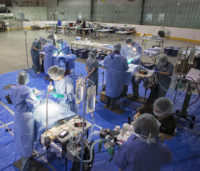
Out on the hockey rink’s cement surface, a masked, blue-gowned veterinary student carefully unwraps a package of sterile surgery equipment. A veterinarian, also in surgical scrubs, gives her directions. Six identical tables are prepped and waiting for their feline and canine patients. Soon after, there’s a quiet flurry of activity as the weekend’s first wave of spay and neuter surgeries …
October 24th, 2014 Full story »

-
Going to the dogs for cancer models
A dog owner who shows up at the Western College of Veterinary Medicine (WCVM) with a pet that has lymphoma might be surprised to see a molecular geneticist and an internist from the College of Medicine on the team of specialists handling the case. Professor Troy Harkness from the Department of Anatomy and Cell Biology and Dr. Terra Arnason, a …
October 13th, 2014 Full story »

-
Spay-neuter clinics address pet health issues
It’s a Saturday morning in May, and my lab mates and I arrive early for the Canine Action Project’s (CAP) spay-neuter clinic at the elementary school in Little Pine First Nation — a community about 80 kilometres northwest of North Battleford, Sask. I’m helping out with the clinic, but I’m also here to collect dog poo. It’s part of my summer …
October 13th, 2014 Full story »