companion animal health

-
A rare reaction for a rare cat
My cat Bart is my best friend. When I’m sad, he jumps to where I am and lies down for pets and cuddles. He goes crazy for chicken liver cat treats. And when I come home from a long day at university, he greets me at the door. Last year, I adopted Bart from a local pet shelter when he …
July 17th, 2023 Full story »

-
Oncologist targets cancer challenges
Growing up around dogs, cats, turtles and chickens at his family’s home in Japan, Dr. Arata Matsuyama (DVM, PhD) knew from a very early age that he wanted to work with animals in veterinary medicine. But what wasn’t part of Matsuyama’s initial plan was devoting himself to studying cancer in companion animals — a decision that eventually brought him to …
July 17th, 2023 Full story »

-
CAHF research summaries (2023-24)
Is methadone effective in managing ferrets’ pain?Drs. Barbara Ambros, Jane Shin, and Isabelle Desprez, WCVM; Dr. Heather Knych, University of California, Davis There’s very little scientific information about pain relief in ferrets, and veterinarians often rely on pain management protocols developed for other animals to treat this species. What’s challenging is that no one has specifically studied how ferrets react …
July 07th, 2023 Full story »

-
Toys support canine cancer patients
Getting a diagnosis of pet cancer isn’t easy for pet owners, but an organization called Kali’s Wish Cancer Foundation is offering to help with something that no dog can resist: toys. Kali’s Wish is the only Canadian organization aimed at supporting pets and their owners after a pet cancer diagnosis and during treatment. It was created in memory of Kali, …
February 18th, 2023 Full story »

-
CAHF research: 2022-23
Five research teams at the Western College of Veterinary Medicine (WCVM) have received nearly $93,000 in funding for research projects targeting a variety of health issues and questions in companion animals. The WCVM’s Companion Animal Health Fund (CAHF) and another fund administered by the CAHF provided financial support for the research studies that are based at the veterinary college. What …
February 18th, 2023 Full story »
-
Pet health studies gain vital support
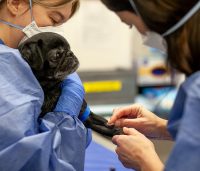
Five research teams at the Western College of Veterinary Medicine (WCVM) have received over $93,000 in funding for research projects targeting a variety of health issues and questions in companion animals. The WCVM’s Companion Animal Health Fund (CAHF) and another fund administered by the CAHF provided financial support for the research studies that are based at the veterinary college. For …
February 18th, 2023 Full story »

-
Pet health research in print
A roundup of WCVM-related companion animal research articles that have been recently published in peer-reviewed journals. Cotter B, Zwicker LA, Lavallee J, Perdrizet UG, Allen AL, Sukut S, Matz B. “Bronchocutaneous fistula in a dog.” Journal of Small Animal Practice. April 2022. 63(4):336. Leis ML, Sandmeyer LS. “Diagnostic ophthalmology.” Canadian Veterinary Journal. May 2022. 63(5):549-550. Meachem MD, Allen AL. “What …
January 18th, 2023 Full story »

-
Scientists seek golden retrievers
Veterinary ophthalmologists at the Western College of Veterinary Medicine (WCVM) are seeking golden retrievers to participate in a genetic study of a blinding eye disease that affects this breed. Golden retriever cystic uveal disease or pigmentary uveitis is an insidious, blinding condition that has become common in the breed. The disease causes thin-walled cysts to develop in the affected dog’s …
January 18th, 2023 Full story »

-
Stray cat gets new outlook on life
Two years ago, a stray grey tabby cat showed up in a neighbourhood in south Regina, Sask. Since then, “George” has stolen the hearts of many people there — including Christine Holzer. “I feed birds and squirrels, so there’s a lot of food and fresh water out all the time. I’m sure the birds probably attracted him to my yard,” …
November 15th, 2022 Full story »

-
Preventing canine parvovirus
Canine parvovirus 2 (CPV-2), more commonly known as “parvo,” is a highly contagious virus that attacks a dog’s gastrointestinal tract. Unvaccinated puppies younger than four months are in the “high risk” category for this often-fatal disease. The most common symptoms of parvo include vomiting, diarrhea, a loss of appetite and decreased energy. Continuous bouts of vomiting and diarrhea can lead …
October 18th, 2022 Full story »